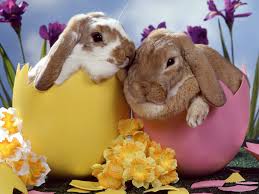
Assorted furry baby critters, new life, unfurling flowers...
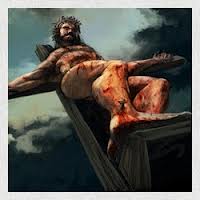
Or erm Crucification. Take your pick people!
How The Christians Stole Easter!
The Easter holiday can be a perfect time to spend with family and friends, making it a very enjoyable time of year. However, there are many people whose main focus for the Easter celebrations is of a spiritual nature, focusing on the death and rebirth of Jesus Christ.
This means that many people automatically view Easter as being a Christian holiday but there is also an argument that the origins of Easter drew heavily from the Jewish celebration of Passover or perhaps from an even earlier time in human existence.
Was it a Good Friday?
One of the problems of Easter in the Christian world is that so many of the elements are as twisted as the crown of thorns that were placed on the head of Jesus. When you take the term “Good Friday”, you have to think that there was not a lot of good about a man being crucified to death. In fact, if that is termed a good Friday no one should ever contemplate what a bad Friday consists of!
With respect to Passover, many people would have concerns about celebrating the story of a God who “passed over” the chosen ones on his way to killing the first born child of Egypt. Both of these stories regarding the origins of the celebrations have negative connotations and do not sit easily with the current Easter tradition of Easter bunnies and rolling eggs.
Spring is a time for optimism and looking forward, which perhaps sits at odds with many people’s take on a Christian Easter or a Jewish Passover. It may be that you prefer to associate this time of year with the blossoming of flowers and the emergence of the sun after a number of months of cold and depressing weather.
There are possible origins from a Pagan celebration
This is a perfectly acceptable viewpoint on life and in fact, there are plenty of instances which suggest that this was how the Pagans celebrated this time of year, long before what we know as Easter today came to life or occurred. In Pagan times, there was a Teutonic Goddess called Eastre, who was the Goddess of Spring and fertility. She was much celebrated in these times and a festival of celebration was held in her honour on the day that the vernal equinox fell on.
An equinox happens twice a year and the vernal equinox occurs in the Spring. An equinox occurs as the subolar point (which is the location of the surface of the Earth when the sun’s centre lies directly above) lies on the equator. It stands to reason that the vernal equinox changed date every year, much like the Easter celebration.
Christmas occurs on the same date every year but the Easter celebrations move depending on the sun. This gives further credence to the link to modern day Easter celebrations and the Eastre celebrations. It is also worth drawing comparisons between the Easter bunny and the Pagan symbol of fertility (the rabbit) and the fact that egg painting and rolling was prevalent in both celebrations.
The Easter period is definitely a great time to spend with friends and family members but you may want to give some thought as to what you are actually celebrating or commemorating. The Christian and Jewish faiths both have strong reasons to commemorate this time of year but there is also a strong argument that suggests the Pagans started the celebrations that we acknowledge today at Easter.